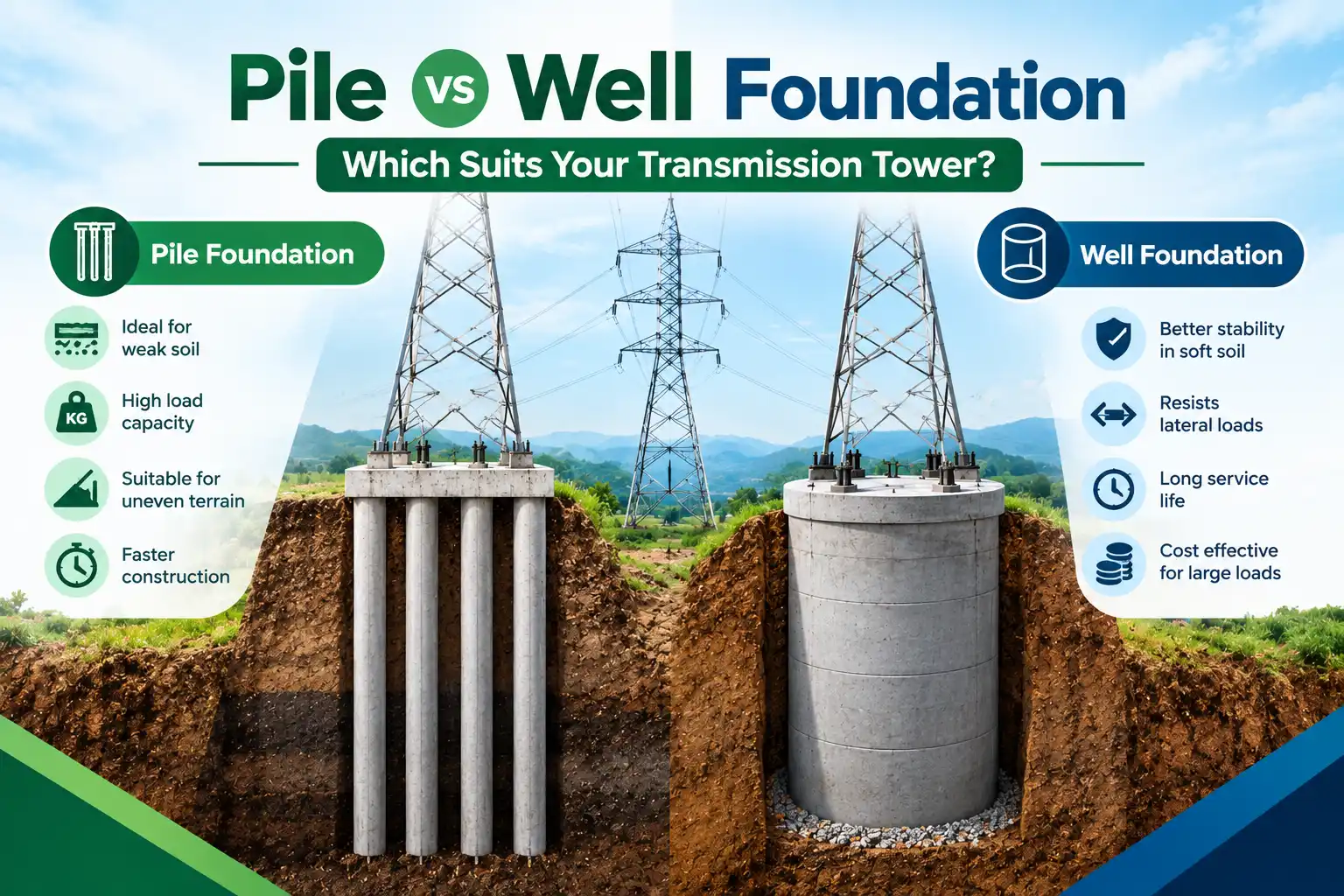
A pile foundation transfers tower load down to deeper, more stable soil through driven or bored piles, and typically suits soft, loose, or waterlogged ground. A well foundation is a large hollow structure sunk into the ground as a unit, and suits locations where a tower needs very high load-bearing capacity or where soil conditions make individual piles impractical. Which one your project needs comes down to the geotechnical report, not a general preference.
Why this decision isn’t optional — the soil decides it
Foundation type on a transmission line isn’t a design taste; it’s a response to what the geotechnical investigation finds at each tower location. Two towers a few kilometers apart on the same line can need completely different foundation types if the subsurface conditions differ. This is also why foundation planning has to happen tower-by-tower, not as a single blanket decision for the whole route.
Pile foundation vs well foundation: how they actually differ
| Factor | Pile Foundation | Well Foundation |
| Best suited soil | Soft, loose, or waterlogged ground | Locations needing very high load-bearing capacity |
| Construction method | Driven or bored piles, then capped and reinforced | Hollow structure sunk as a unit, then filled/sealed |
| Typical use case | Standard tower locations with variable or soft strata | River crossings, heavy-duty towers, high-load sections |
| Equipment needs | Piling rigs, reinforcement placement | Sinking/dewatering equipment, larger excavation |
| Schedule sensitivity | Moderate — depends on pile depth and soil variability | Higher — sinking and dewatering can extend timelines in wet ground |
What a pile foundation actually involves on site
Pile foundations work by carrying the tower’s load past weak surface soil down to a stronger stratum. On site, that means positioning and installing piles to the design depth, followed by reinforcement placement and capping to tie the piles into the tower base. It’s the more common foundation type across a typical transmission line simply because most tower locations don’t need the extra load capacity a well foundation provides — pile foundations handle the majority of standard ground conditions efficiently.
What a well foundation actually involves on site
A well foundation is built differently: a hollow cylindrical or rectangular structure is sunk into the ground, often with the help of dewatering, and progressively filled and sealed as it reaches design depth. This method suits locations — river crossing towers being the clearest example — where the load-bearing demand is unusually high, or where the ground itself (loose sand, high water table) makes conventional piling less reliable. It’s more equipment- and time-intensive, which is part of why it’s reserved for specific high-demand locations rather than used across a whole line.
Who decides pile vs well foundation?
The geotechnical investigation and structural design team make this call, based on soil test results (bore log data, load-bearing capacity, water table depth) at each tower location, matched against the tower’s design load. It isn’t a contractor preference or a cost-driven default — it’s an engineering conclusion drawn from what the ground at that specific spot can actually support.
Does soil type change the construction timeline?
Yes, meaningfully. Pile foundation work in stable, accessible soil generally moves faster than well foundation work, which often requires dewatering and more extensive excavation. On a real project, foundation type mix across the route — how many locations need well foundations versus standard piling — is one of the clearer early indicators of how the civil works phase will pace against the overall schedule. This is also where soil variability along a route (common in Northeast India’s mixed hill and floodplain terrain) can create schedule risk if it isn’t accounted for early in geotechnical surveying.
Why river crossings usually mean well foundations
River crossing towers carry some of the highest structural demands on a transmission line — longer spans on either side, higher conductor tension, and often taller tower heights to maintain clearance over the waterway. That combination of high load and, frequently, loose or sandy riverbed soil is exactly the scenario well foundations are built for: a single large structure sunk deep enough to reach stable bearing strata, wide enough to distribute the tower’s load safely. Attempting a standard pile foundation in this kind of ground and load combination would typically require an impractical number of piles, at which point a well foundation becomes the more efficient engineering solution rather than just an alternative.
What can go wrong when foundation type is misjudged
Getting foundation type wrong at a location — or executing it without adequate soil investigation — tends to surface later rather than immediately. A tower that settles unevenly, or a foundation that shows stress cracking after a monsoon season of saturation, often traces back to a foundation decision made without sufficiently detailed geotechnical data at that specific point, rather than a construction defect on its own. This is why bore log density (how many soil test points are taken along a route, not just at a sample of “representative” locations) matters as much as the design calculations that follow from it. A route through Northeast India’s mixed hill, floodplain, and river-crossing terrain can see soil conditions change meaningfully within short distances, which makes sparse geotechnical sampling a real risk factor rather than a cost-saving shortcut.
What good foundation execution looks like in practice
Beyond choosing the right foundation type, execution quality matters just as much. That means proper dewatering where needed, correct reinforcement placement to design, and inspection and test plan (ITP)-based quality checks at each stage rather than only at completion. Foundation work is largely invisible once a tower is standing, which is exactly why the QA/QC discipline during construction — not just the design on paper — determines how the structure performs over its service life.
Foundation design itself sits within the framework of IS 4091, the Indian Standard covering design and construction of foundations for transmission line towers, which sets out the engineering basis for both foundation types.
FAQs
Who decides pile vs well foundation?
The geotechnical and structural design team, based on soil test data and the tower’s design load at each specific location — not a general contractor preference.
Does soil type change the construction timeline?
Yes. Well foundations, which often need dewatering and more excavation, generally take longer than standard pile foundations in stable soil, and mixed terrain along a route can affect overall civil works pacing.
Can one transmission line use both foundation types?
Yes, and most do. Foundation type is decided tower-by-tower based on soil conditions at each location, so a single line will typically have a mix of pile and well foundations along its route.
What standard governs transmission tower foundation design in India?
IS 4091 sets out the design and construction requirements for transmission line tower foundations, covering both pile and well foundation approaches, within the broader transmission planning framework the Central Electricity Authority oversees.
Want a foundation execution assessment for your next transmission project? Get in touch with our team, or see how we approach pile and well foundation execution as part of our EHV/HV transmission line construction work.