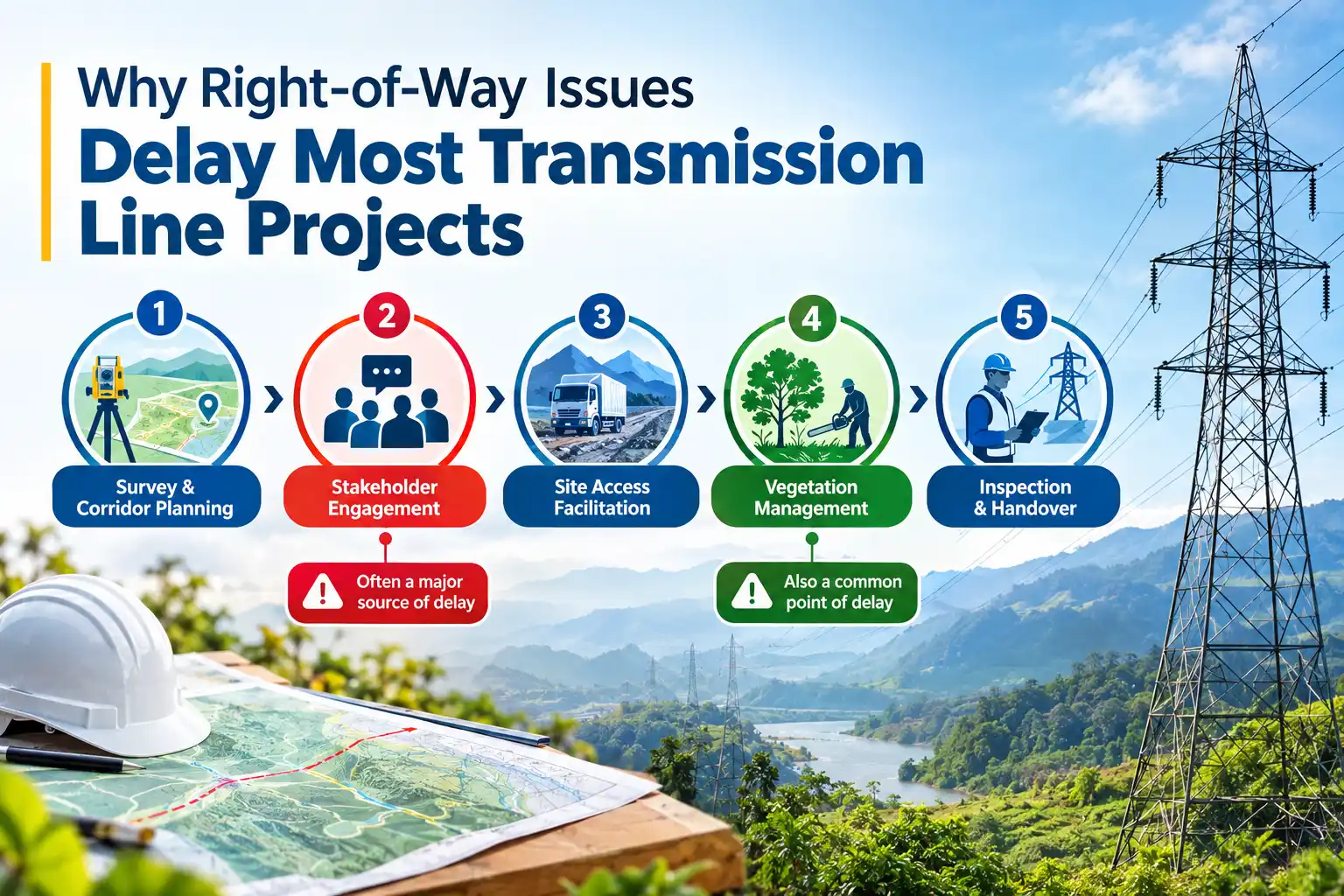
Right-of-way (RoW) is the legal and physical corridor a transmission line needs to be built and maintained along, and problems securing or maintaining it are one of the most common reasons transmission projects fall behind schedule — more common, in practice, than weather or equipment issues. Most RoW delays trace back to two sources: vegetation and land-use encroachment along the corridor, and disputes or slow resolution around land and compensation.
Why RoW causes more delay than people expect
A transmission line doesn’t just need the land directly under each tower — it needs a maintained corridor along the entire route, kept clear enough for safe conductor clearance and future access. That corridor crosses private land, agricultural fields, sometimes forest areas, and occasionally settlements, all of which have to be negotiated, cleared, or compensated according to process. Compared to a delay caused by, say, a monsoon washout, RoW delays are often less visible on a progress report until they’ve already stalled work at multiple locations — because the underlying issue (a land dispute, an uncleared tree line, a compensation disagreement) can sit unresolved for weeks without an obvious construction-site symptom.
The two most common delay sources
Vegetation and land-use encroachment. Trees, plantations, and structures that have grown or been built within the transmission corridor after the original survey — or that were never properly accounted for — routinely block stringing and maintenance access. Resolving this means coordinated clearance work, which has to be planned and communicated with landowners rather than treated as a purely technical task.
Land disputes and compensation disagreements. Where a tower location or corridor section requires compensation to landowners, disagreements over valuation, delayed payment processing, or unclear title can stall access to a site indefinitely. These issues often take longer to resolve than technical construction problems because they run through administrative and legal channels rather than site-level decision-making.
Who is responsible for right-of-way acquisition, the utility or the contractor?
Land acquisition and RoW compensation for a transmission project is generally the responsibility of the utility or project owner, working through the applicable state and central government framework. The EPC contractor’s role is typically execution-stage: coordinating access at each location, managing vegetation clearance within the corridor, and liaising with local stakeholders during construction — not acquiring land or negotiating compensation on the utility’s behalf. Keeping this distinction clear matters, because a contractor that overstates its RoW role risks creating expectations it isn’t positioned to meet.
How does drone inspection help RoW management?
Drone-based corridor inspection has become a practical tool for RoW management because it lets a project team see the actual state of a corridor — new construction, vegetation growth, encroachment — without a physical walk-through of every kilometer. This is particularly useful in Northeast India’s terrain, where some corridor sections are genuinely difficult to access on foot. Regular aerial inspection can flag emerging RoW problems (a new structure near the corridor, unexpected tree growth) early enough to address them before they become a construction-stage blocker.
What good RoW execution support actually looks like
On a well-run project, RoW execution support means the contractor is proactively tracking corridor conditions ahead of construction crews reaching each section — not discovering an obstruction only when equipment arrives on site. It means clear, early communication with local stakeholders about clearance work, and a working relationship with the utility’s land team so that unresolved compensation issues are flagged and escalated rather than left to stall a location indefinitely. None of this replaces the utility’s responsibility for acquisition and compensation, but it meaningfully reduces how often those issues actually stop construction.
How RoW risk compounds across a long, multi-tower corridor
A single tower location with an unresolved land dispute might seem like a minor, isolated issue against a route with hundreds of structures. In practice, RoW problems rarely stay isolated. Construction sequencing on a transmission line is generally continuous — stringing conductor between towers requires access at both ends, so a single blocked location can hold up work at the towers on either side of it as well, even where those neighboring sites have no RoW issue of their own. This is part of why RoW risk deserves attention proportional to its actual schedule impact rather than its apparent scale: one difficult location, left unresolved, can stall progress across an entire section of the route.
Early identification versus late-stage discovery
The projects that manage RoW well generally share one habit: they identify potential corridor problems well before construction crews reach that section, rather than discovering them when equipment is already mobilized on site. That means corridor surveys, updated land records checks, and stakeholder engagement happening in parallel with — and ideally ahead of — the main construction schedule, not as a reactive step once a crew reports being blocked. Waiting until a physical obstruction is discovered on site turns what could have been a planning-stage conversation into a live schedule emergency, often with far less flexibility to resolve it quickly.
Why this matters more than it seems to at the planning stage
RoW risk is easy to underweight during project planning because it doesn’t show up as a technical line item the way foundation type or tower structure does. But on projects where schedules slip significantly, RoW issues are frequently a root cause — sometimes the dominant one. Government guidance on compensation and RoW processes for transmission lines, coordinated through the Ministry of Power and the broader Central Electricity Authority planning framework, exists precisely because this is a recurring, structural challenge across the sector — not a one-off issue specific to any single project or region.
FAQs
Who is responsible for right-of-way acquisition, the utility or the contractor?
Land acquisition and compensation is generally the utility’s or project owner’s responsibility. The EPC contractor’s role is execution-stage RoW coordination and access facilitation, not acquiring land.
How does drone inspection help RoW management?
It lets project teams monitor corridor conditions — encroachment, vegetation growth, new construction — without a full physical walk-through, catching emerging issues early, especially in hard-to-access terrain.
What are the most common causes of RoW delays?
Vegetation and land-use encroachment along the corridor, and land disputes or compensation disagreements, are the two most frequent sources of RoW-related schedule slippage.
Can RoW issues really delay a project more than weather does?
Often, yes. Weather delays are visible and generally time-bound; RoW issues (an unresolved land dispute, uncleared encroachment) can sit unresolved for extended periods and are frequently underweighted in early project planning.
Facing RoW risk on an upcoming transmission corridor? Talk to our team about execution-stage coordination, or see how we approach right-of-way management as part of our transmission line services.