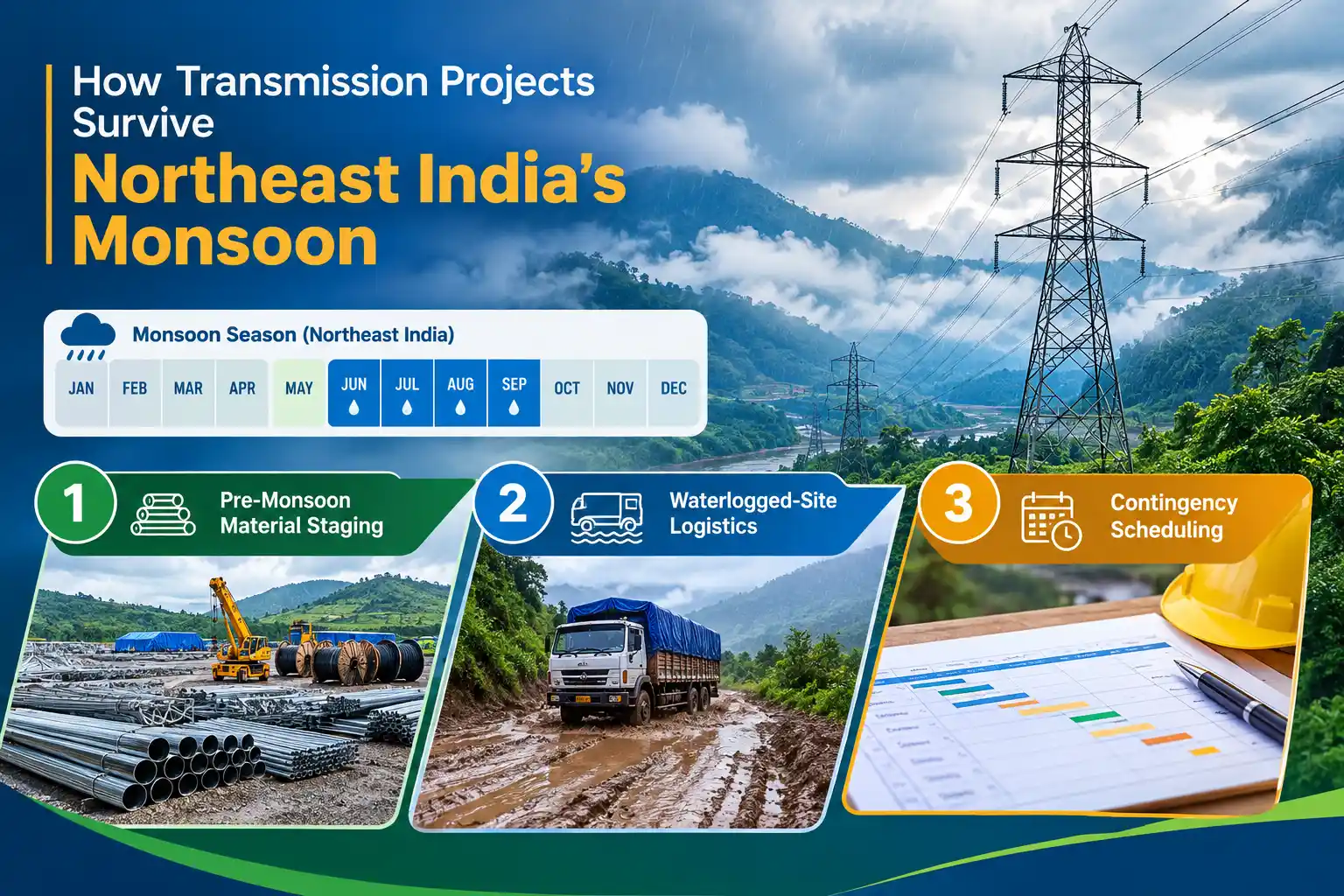
Northeast India sees roughly 6 to 8 months of monsoon conditions a year, which means transmission line construction here can’t be scheduled around the rain — it has to be scheduled through it. Projects that stay on track do it with three practices: sequencing civil work ahead of the heaviest months, pre-positioning material before access routes get difficult, and keeping erection crews ready to move fast in the shorter dry windows.
Why “wait out the monsoon” isn’t a real option
On a plains project, a few months of reduced activity during monsoon is a manageable pause. In the Northeast, where the wet season runs more than half the year, that approach simply doesn’t leave enough working calendar to hit a realistic completion date. Projects here are planned assuming the monsoon is part of the execution environment, not an interruption to it — which changes how foundation work, material logistics, and even workforce planning get sequenced from day one.
Three things that keep execution moving
1. Sequencing foundation and civil work ahead of the wettest months. Foundation work — particularly excavation, piling, and concreting — is the most weather-sensitive stage of tower construction. Getting as much of this work done in the drier months, location by location, reduces how much critical-path work is left exposed to the heaviest rainfall period later in the year.
2. Pre-positioning material before access gets difficult. Many tower locations in hill and remote sections become far harder to reach once monsoon rains set in — unpaved access tracks wash out, and river crossings that were manageable in the dry season become genuinely risky. Moving steel, cement, and reinforcement to staging points before the access window closes is often the difference between a location that stays on schedule and one that stalls for weeks.
3. Keeping erection crews ready for shorter dry-window bursts. Even within the monsoon period, there are drier stretches — and the projects that keep pace treat those windows as high-intensity erection opportunities rather than ad hoc work periods. That means having crews, cranes, and rigging already mobilized and ready, rather than mobilizing after a dry spell has already started.
What this looks like on the ground
In practice, monsoon-resilient execution changes the shape of a project schedule. Instead of a steady, evenly paced construction curve, you get a front-loaded push on foundation and material logistics before the heaviest rains, a slower-paced but still active period through the core monsoon months (site protection, partial works, planning), and a fast erection and stringing push once conditions improve. Recognizing and planning for that rhythm — rather than assuming a uniform pace across twelve months — is one of the clearer markers of a contractor with real regional execution experience.
Does construction stop during monsoon in the Northeast?
Not entirely, though the mix of activity changes. Weather-sensitive work like foundation concreting and tower erection at exposed or difficult-access locations may pause or slow during the heaviest rainfall, but material logistics, site preparation, and lower-risk civil works often continue. The goal is to keep the project moving in whatever form conditions allow, rather than a full stop-and-restart approach.
How is material moved to remote sites during heavy rain?
This depends heavily on advance planning. Where possible, material is pre-positioned at or near tower locations before access routes deteriorate. For locations that remain reachable only with difficulty, contractors may use manual portage, temporary track reinforcement, or scheduling deliveries around shorter breaks in rainfall. The core principle is minimizing how much material movement has to happen during the worst-access periods, rather than solving the access problem after the fact.
Workforce and safety considerations through the monsoon
Monsoon execution isn’t only a materials and scheduling problem — it’s a workforce one too. Slippery access tracks, saturated ground around excavations, and reduced visibility during heavy rainfall all raise the baseline risk on a construction site. Projects that handle the monsoon well tend to build specific safety protocols for the season into their site procedures, rather than applying the same safety plan year-round and hoping conditions cooperate. That includes more conservative go/no-go calls for crane and erection work during active rainfall, additional footing and access reinforcement around excavation sites, and closer monitoring of drainage around foundation work to prevent water accumulation from compromising freshly poured concrete.
Retaining a stable local workforce through the monsoon months also matters more in this region than it might elsewhere. Contractors who rely on workers mobilized from outside the region for short stints often see higher turnover and slower ramp-up when conditions improve, because a workforce unfamiliar with the terrain and the local monsoon rhythm takes longer to become fully productive. A contractor with an established regional base — workers who already understand what a given site looks like and behaves like across a full annual cycle — tends to lose less time to this kind of restart friction.
Why this matters for project planning, not just execution
For utilities and project owners evaluating contractors or setting tender timelines for Northeast India projects, monsoon planning capability is a genuine differentiator — not a soft factor. A completion schedule that doesn’t account realistically for a 6-8 month monsoon window, based on the region’s typical rainfall patterns as tracked by the India Meteorological Department, is a schedule that’s likely to slip regardless of how capable the contractor otherwise is. Asking a prospective contractor to walk through their specific monsoon-season execution plan — not just acknowledge that monsoon exists — is one of the more useful things a procurement team can do during evaluation.
FAQs
Does construction stop during monsoon in the Northeast?
Not completely. Weather-sensitive work like foundation concreting may pause at difficult-access locations, but material logistics, site preparation, and lower-risk works generally continue, with erection and stringing pushed hard during drier windows.
How is material moved to remote sites during heavy rain?
Primarily through pre-positioning material before access routes deteriorate, supplemented by manual portage or temporary access measures at locations that remain hard to reach once the rains set in.
How long is the monsoon season in Northeast India?
Typically around 6-8 months, depending on the specific state and year, based on regional patterns the India Meteorological Department tracks.
Why does monsoon planning matter for tender evaluation?
A completion timeline that doesn’t realistically account for the region’s monsoon window is a schedule risk in itself — evaluating a contractor’s specific monsoon-season execution plan is a practical way to gauge regional execution readiness, consistent with broader transmission project planning norms the Central Electricity Authority sets out.
Have a project timeline that needs to work around monsoon-season realities? Discuss it with our execution team, or see how monsoon logistics factor into our approach on our services and about us pages.