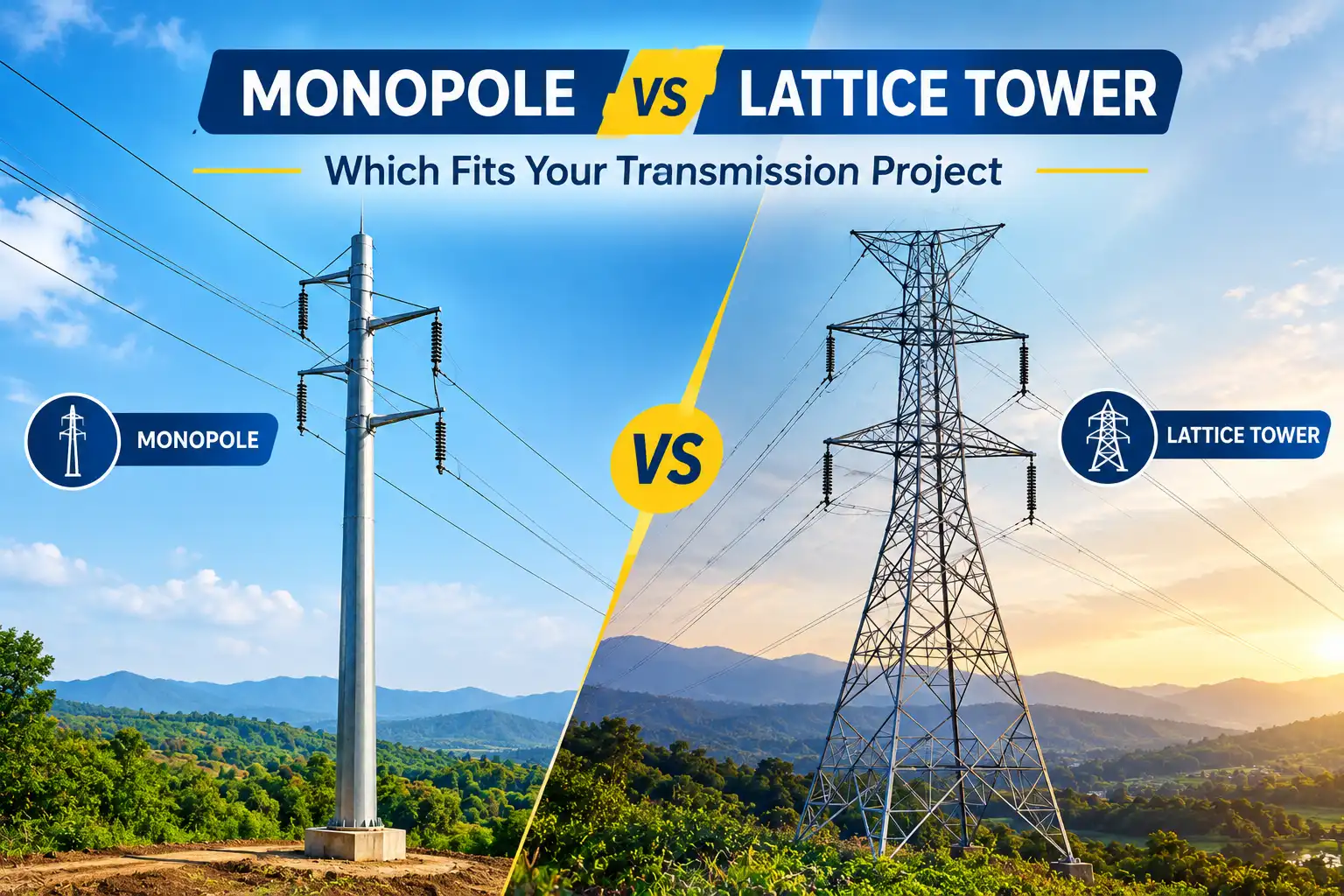
A monopole is a single tapered steel or concrete pole that carries conductors on a compact footprint, best suited to urban or right-of-way-constrained corridors. A lattice tower is a braced steel structure with a wider base, built for longer spans and higher load capacity, and remains the default choice for most long-run EHV lines. The right call depends on terrain, span length, and how much land you can actually secure at each location.
The real decision isn’t “which is better” — it’s “which fits this corridor”
Engineers rarely get to pick a tower type in isolation. The decision is downstream of land availability, span requirements between structures, and how much vertical or lateral load the line needs to carry. Treating this as a single global choice for a project, rather than a per-section one, is where a lot of design revisions come from later.
Monopole vs lattice tower: a direct comparison
| Factor | Monopole | Lattice Tower |
| Footprint | Compact, single-pole base | Wider base, four-legged structure |
| Best suited for | Urban stretches, RoW-constrained sections, aesthetic-sensitive areas | Long-span EHV runs, open corridors, higher load requirements |
| Erection speed | Generally faster per structure | Slower — more assembly and bracing |
| Load/span capacity | Lower to moderate, depending on design | Higher, suited to longer spans and heavier conductor bundles |
| Visual profile | Lower visual impact, easier public acceptance in populated areas | More visible, larger physical presence |
| Maintenance access | Simpler in constrained sites | Standard climbing/maintenance access |
When a monopole makes sense
Monopoles earn their place where land is the constraint, not load. A line passing through a town, along a highway corridor, or through an area where acquiring a full four-leg tower footprint would mean displacing more structures or negotiating more parcels, is a strong candidate for monopole sections. The narrower base also helps where verticality control matters — monopoles hold their line more predictably in tight urban geometry than a lattice structure would in the same footprint.
When a lattice tower is the right call
For most long-distance EHV transmission — the kind covering open agricultural land, hill sections with wider corridors, or river crossings needing extra load margin — lattice towers remain the standard. Their bracing geometry distributes load across four legs, which is what makes them practical for longer spans between structures and for carrying multiple circuits or larger conductor bundles. Cross-arm installation and load configuration are also more flexible on a lattice structure, which matters when a line’s design load isn’t finalized down to the last detail before construction starts.
Can a monopole carry a 220kV line?
Yes — monopole design has advanced enough that 220kV (and in some cases higher) circuits can run on monopole structures, provided the pole is engineered for the specific load, span, and wind conditions of that section. It’s a structural design question, not a fixed voltage ceiling. What usually decides it in practice is whether the corridor’s land constraints justify the design and fabrication effort a custom monopole solution requires.
Which is cheaper to install?
There’s no single answer that holds across a whole line. Lattice towers are often cheaper per structure at standard spans because the design and fabrication is more standardized. Monopoles can cost more per structure but reduce land acquisition costs and civil works in constrained sections — and can lower the total tower count if spans are optimized. The real comparison has to be done at the section level, factoring in land cost, foundation type, and erection logistics together, not steel cost alone.
Foundation and erection implications of each choice
The tower type decision doesn’t stop at the structure itself — it carries through to foundation design and erection method. Lattice towers, with their four-legged base, typically need four separate footing excavations per structure, each sized to the load that leg carries. Monopoles concentrate the entire load into a single, larger foundation, which usually means a bigger single excavation and a heavier reinforcement and concrete pour at that one point rather than four smaller ones.
Erection sequencing also differs. Lattice towers are assembled section by section, often built up in stages with cranes or gin poles, which gives some flexibility in constrained sites but takes longer per structure. Monopole sections are typically fabricated as one or a few large pre-assembled segments and lifted into place as a unit — faster on site, but more demanding on transport logistics, since a large single-piece pole is harder to move into a difficult-access location than modular lattice components that can be broken down for transport and reassembled at site.
Wind load and terrain considerations
Wind loading behaves differently across the two structure types, which matters directly for Northeast India’s mix of hill and open terrain. Lattice towers’ open, braced geometry lets wind pass through the structure rather than load against a solid surface, which is part of why they scale well to taller, longer-span applications. Monopoles present a more solid profile to wind, which becomes a bigger factor in structural design as pole height and conductor load increase — meaning a monopole solution for a higher-load or higher-elevation section may need a more conservative, and more expensive, design than the same solution at a lower-wind-exposure urban location.
How this gets decided on a real project
In practice, a transmission line design rarely uses one tower type end-to-end. A typical corridor through Northeast India, for example, might use lattice towers through open and hill terrain where spans are long, switching to monopole sections through populated stretches where RoW is tight. Getting this mix right at the design stage — rather than redesigning after land acquisition stalls — is one of the more overlooked ways an EPC contractor can protect a project’s schedule.
Structure design also has to sit within the framework set out in IS 802, the Indian Standard governing the use of structural steel in overhead transmission line towers, which covers load, wind, and safety factor requirements for both tower types.
FAQs
Can a monopole carry a 220kV line?
Yes, provided it’s engineered for the section’s specific load and span requirements — it’s a design question rather than a fixed voltage limit.
Which is cheaper to install, a monopole or a lattice tower?
It depends on the section. Lattice towers are often cheaper per structure; monopoles can reduce land and civil costs in constrained corridors. Compare at the section level, not tower-for-tower.
Do most transmission lines use only one tower type?
No. Many lines mix tower types by section — lattice for long open spans, monopole for urban or RoW-constrained stretches — based on terrain and land access at each location.
How is tower type decided during project design?
It’s driven by span length, load requirements, land availability, and terrain at each section, evaluated against the structural provisions in IS 802 and the project’s overall transmission planning framework, which bodies like the Central Electricity Authority oversee at the sector level.
Not sure which structure fits your corridor? Ask our engineering team which tower type suits your site conditions, or see how we approach monopole erection and lattice tower works as part of our broader EHV/HV transmission line construction services.